Showing posts with label book reviews. Show all posts

Friday, January 29, 2010

Demian

Author: Herman Hesse
Year: 1919

I first read Demian in college and was blown away by it. The novel is a classic example of the bildungsroman or coming of age story, that usually has as much to say about it's central character as it does about society as a whole. Hesse seems to specalize in this type of novel, since every other book I've read of his (Steppenwolf, Siddartha, Peter Camenzind) seems to follow this pattern. To his credit, however, all of these novels say radically different things and work with a nice variety of characters and settings.

Demian is not as widely known as a few of the others I mention, and I think I now understand why. A deep understanding of Jungian psychology is practically required to understand all the undercurrents of protagonist Emil Sinclair's journey from meek, put-upon youth to iconoclast mystic. While I enjoyed the early threads of Sinclair's struggles with discovering his true self and place in the world, later episodes of magical realism fell flat to me. The mystery of Demian's power and influence is never properly accounted for, and the book seems to sputter out rather than reach a grand conclsion (a la Siddartha).

With that said, though, Hesse's novel is stuffed with psychological dilemnas to ponder over. And for about 2/3 of the book, he also recounts some compelling events. Though the ending left me cold from a dramatic standpoint, Hesse's prediction of the birth of the modern mind with the beginning of World War I seems relevant and prescient today.
Rating: Brass
Sunday, August 16, 2009

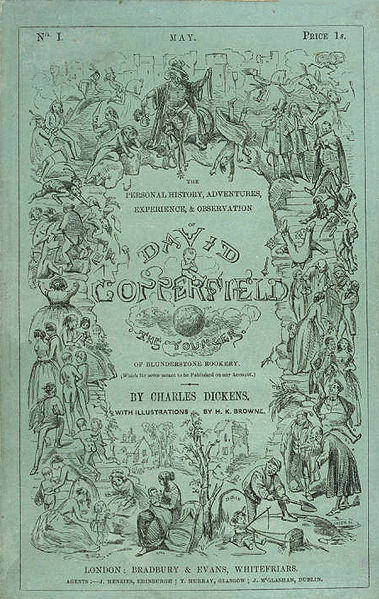
David Copperfield

Author: Charles Dickens
Year: 1850

Having struggled through several other Dickens novels, I decided to give David Copperfield a try. It is rumored to be his greatest work (along with Great Expectations, which was a bit disappointing, to me at least) so I was hoping it might possess something that elevated it among the others. Well, within the first chapter of the 800+ page novel, I found that the rumors were true. David Copperfield is a complete masterpiece. Beginning with the night of his birth and ending several decades later, this epic novel is a perfect example of Dickens' hearty sense of humor, deep pathos for his characters, and strong outrage against the injustices of modern life. Unlike other Dickens novels, the meandering sideplots only deepen the novel and create a world where every character's life tells a fascinating story.

Readers more used to modern conventions of realism and frank storytelling may be a bit put off by Dickens' whimsical characterizations and use of staggering coincidence. But these were very common in his time, when novels were published in monthly or weekly serial installments. The use of coincidence can be a exaggerated at times, but Dickens uses it more tastefully here than in previous novels (Oliver Twist and Great Expectations spring to mind). And it is always used to enhance the drama of the individual stories, giving them deeply ironic twists that could never occur when simply reciting things as they would probably occur. Similarly, the intense villainy of Uriah Heep, the naive pompousness of Wilkins Micawber, and the angelic goodness of Agnes Wickfield (to name a few) may seem exaggerated and one-dimensional, but nonetheless these characters greatly enhance the narrative and stand as some of the most unique individuals in literature.

There are so many incredible events over the course of the novel, that I am reluctant to give anything away. So I'll leave you with the memorable opening line to hopefully whet your appetite: "Whether I shall turn out to be the hero of my own life, or whether that station will be held by anyone else, these pages must show."

Value: Gold

Wednesday, September 10, 2008

The Sun Also Rises

Author: Ernest Hemingway
Year: 1926


Hemingway's first novel used to be my one of my all-time favorite reads. There was something about the directionless plot, exotic locales, and matter-of-fact dialogue that struck me as wholly fresh and liberating. Coming back to the novel several years later, I can still appreciate those elements, but I've come to realize the truth of the cliche that "Hemingway's true genius is in his short stories." Though characters like war-scarred Jake Barnes and tragically romantic Robert Cohn are interesting, their private dramas begin to burn out after even a slender 250 page novel.

Perhaps most frustrating about the novel is Hemingway's choice of subject matter. The group of men and women he depicts are mostly wealthy expatriates whose ennui and irreverence are hard to relate with. The most earnest and sympathetic character is Barnes, though even his struggles occasionally lapse into the realm of self-pitying despair. The best line in the whole novel is delivered by him during an all-night session of insomniac pondering: "I did not care what it is all about. All I wanted to know was how to live in it." And for the most part, the novel reflects this philosophy, showing Barnes' attempts to appreciate the beauty of his surroundings despite the shenanigans of his peers and the agony of his handicap.

The Sun Also Rises still holds up as a classic, perhaps a work of a young author meant to be enjoyed by men and women still in their youth. Though seeming to profess a viewpoint of disillusionment, Hemingway's novel revels in its illusions of European decadence and wild lives free from the concerns of consequence.

Value: Silver

Monday, July 21, 2008

Tender is the Night

Author: F. Scott Fitzgerald
Year: 1934

It’s hard to read Tender Is the Night without paralleling it to The Great Gatsby as well as Fitzgerald’s personal life. In a sense, this novel is another account of the eventual frustration and defeat of the American dream. Unfortunately, it does not dazzle in the same way that Gatsby does, and while the writing is solid and the plot compelling, Tender Is the Night falls far short of achieving the same level of transcendence.

The novel begins with an interesting bit of misdirection, placing the reader in the shoes of young starlet Rosemary Hoyt as she meets the true main characters, Dick and Nicole Diver. Dick Diver is a supreme example of American promise, but despite all his intelligence and privilege, his story ends much like that of Jay Gatsby. The relationship between the Divers (clearly echoing many aspects of Fitzgerald and his wife Zelda) is at times heartbreaking and exhilarating, but most often seems like a detached clinical study. I suppose this treatment may be an intended reflection of the Divers’ own detachment, but it manages to make the novel frustratingly distant in many sections. Most compelling is the subtly changing dynamic of the couple: through the course of the novel we see Nicole’s slow recovery while witnessing a parallel regression in Dick. It is as if her well-being is necessitated upon his gradual destruction.

There are a few scattered moments of striking beauty and insight, like when Dick, with extraordinary self-perception, muses, “The strongest guard is placed at the gateway to nothing. . . . Maybe because the condition of emptiness is too shameful to be divulged.” Also, the ending notes possess a somber grace lacking in the rest of the novel, that one almost wants to begin again and re-experience the journey in a new light. But on the whole, the poetic encapsulation of American history and culture that is so prevalent in The Great Gatsby is woefully underrepresented here, leaving us with only another sad tale of the Lost Generation.


Value: Iron

Monday, July 7, 2008

Nine Stories

Author: J.D. Salinger
Year: 1953

Despite having only four books available for purchase, Salinger is a legend among writers. There is something about his work that inspires obsession. Widely praised for The Catcher in the Rye, he is more fanatically followed by devotees of the pieced-together Glass Family stories. But what is it about his humble prose and simple (or non-existent) plots that garners so much attention? Nine Stories is book-ended by two pieces steeped in mystery. These stories, “A Perfect Day for Bananafish” and “Teddy” are simultaneously exuberant and despairingly haunted. They describe events with clear surface drama, but underneath swarm layers, if not worlds, of gloomy implication and wonderment. Perhaps you can tell that I don’t want to divulge too much detail…

In between you get a rather hit-or-miss assortment. The middle of the collection features the best stories: “The Laughing Man” is a bittersweet account of a “Comanche Club” youth group and their yarn-spinning counselor; “Down at the Dinghy” is a simple and touching account of a mother and her son; and “For Esme – With Love and Squalor” is Salinger’s brief epic of a soldier’s meeting with a precocious thirteen-year old days before shipping off for the Normandy Invasion. Unfortunately, these stellar tales (along with the hilarious “De Daumier-Smith’s Blue Period”) are balanced with pointless disinterested pieces like “Pretty Mouth and Green My Eyes.”

As usual, Salinger’s primary focus is the meeting of adolescence and adulthood; nearly every story in the collection focuses on these contrasting viewpoints. Once again, the two bookend stories provide the keenest insight into Salinger’s ideas on the matter. In “Bananafish,” Seymour Glass tells his young companion a quirky story about a peculiar fish that retreats into its undersea cave, then eats too many bananas and gets too fat to ever come out again. A metaphor for the loss of freedom and innocence upon the entrance into adulthood, Salinger expands upon this theme in “Teddy” where the titular character theorizes that the only way for people to return to their original state of being is to “vomit up” as much of the apple of original sin (in Teddy’s view, this represents reason and logic) as possible. For Salinger fans, this collection is a must-read (especially since two of the stories deal directly with Glass Family members, while a third makes extensive reference to one). Even for Holden Caulfield haters, these should be enough honesty and beauty in these stories to make the short read highly worthwhile.

Value: Brass

Monday, June 30, 2008

All the Pretty Horses

Author: Cormac McCarthy
Year: 1992

Cormac McCarthy seems to be everywhere right now—Oprah’s book club, a recent Coen Brothers film adaptation, one of the top novels of the past quarter-century. I decided it was time to check out his work, since he’s considered the modern Faulkner, and a great depicter of the violent and beautiful American southwest. All the Pretty Horses both lives up to my expectations and kind of frustrates them. The novel starts out gloomy with the funeral for protagonist John Grady’s grandfather, turns comedic when Grady and his friend cross the border into Mexico in search of adventure, then shifts into a semi-melodramatic romance, finally returning to a state of pitch-black gloom and despair. All throughout, McCarthy retains a distance from the world of the novel, coldly surveying the raw beauty of the Mexican landscape and stubbornly refusing to enter the heads of his equally stubborn characters. In some ways, this narrative distance works quite well, amplifying the frankness and simplicity that Hemingway is known for. But it also prevents the novel from striking home on any real emotional level.

The most problematic part of the novel is Grady’s passionate love for a ranch owner’s daughter, Alejandra. The two are a sort of Romeo and Juliet pair, deeply desiring one another, but knowing that their love can never be allowed to flower. The romance, however, is jarringly out of place with the events in the rest of the novel, and feels a little bit contrived. Especially irritating is the lack of insight into Alejandra’s character; she is given no more than a handful of lines, and it is never really clear what she sees in run-down, dirt-poor Grady.

Minor criticisms aside, the icing to top off this striking novel is McCarthy’s metaphysical musing that underlies all the events of the novel. Most profound is his consideration of the workings of Fate in human activities. One of the best passages in the novel occurs when Grady confronts Alejandra’s grand-aunt for the second time. She is determined to prevent him from stealing off with her protégé, but respects him enough to deliver a haunting and thorough account of her reasoning. She expresses her deep frustration with the randomness of life, describing a coin minter who arbitrarily decides which way to press each coin he makes, blindly affecting countless coin flips down the road. She laments the inability of mankind to ever know the alternative course that their actions could have taken; for a history that never sees the light of day, and can never be judged against what actually transpired. Building off this theme is Grady’s fascination with the long-dead frontier of the American West. Early in the novel we see him wistfully imagining the hunting parties of the glorious and departed Native American tribes, disappearing in the red light of the setting sun. At the end of the novel, Grady likewise disappears, fading into history like so many movements whose splendor the world will never see.


Value: Brass

Friday, June 6, 2008

A Confederacy of Dunces

Author: John Kennedy Toole
Year: 1980 (though written some twenty years earlier)

A Confederacy of Dunces may be the funniest novel I’ve ever read. The only competition that I can think of (The Sot-Weed Factor by John Barth, Cat’s Cradle by Vonnegut, or The Crying of Lot 49 by Pynchon) pale in comparison. At the novel’s heart is the grossly overweight, highly opinionated and deliriously deluded Ignatius J. Reilly. You will not find a more unique and hilarious character in all of literature. Thoroughly sickened by the lack of medieval values in the post-Enlightenment world, Ignatius is determined to live out his life in the comforting cloister of his mother’s home, spending his days scribbling an elaborate protest against the modern world. That is, until a bizarre series of circumstances forces him out into the world where he must use his Masters-degree education to, gasp, finally get a job!

As the story progresses (and the plot becomes more and more wildly improbable), a number of gut-busting hilarious scenes ensue. Stand-outs for me were Ignatius’ “Crusade for Moorish Dignity” complete with an impromptu jazz dance among bewildered factory workers, his disgraceful job as a pirate hot dog vendor (complete with the tantalizing advertisement “Twelve (12) inches of Paradise”), and his short-lived obsession with a Boethius-reading pornographer. Among Ignatius’ more memorable quotes are lines like “Everyone has a valve!” and “Oh Fortuna, you degenerate wanton!”

What keeps Confederacy from being perfect is the elaborate cast of side characters, some wickedly funny, others dreadfully obnoxious, that interrupt the tale of Ignatius’ exile in the outside world. While characters like Patrolman Mancuso and Burma Jones are likable and funny, they are given a few too many pages and not quite enough to do. At times, during the middle section of the novel, it feels like the events aren’t really progressing anywhere. But be patient: the incredible payoff of the ending (which neatly ties up just about every random plot string from earlier chapters) is hilarious, heart-warming, and more than worth the journey.


Value: Silver

Wednesday, June 4, 2008

Moby Dick

Author: Herman Melville
Year: 1851

Moby Dick is a bloated whale of a novel. It’s strange to think that Melville’s epic is considered to be the defining work of American Literature, since I can’t think of another novel more unrepresentative of America’s straightforwardness and economy of language. Hemingway, Twain, or even Jack London spring immediately to mind when I think of the American Novel, but Moby Dick? This is not to say that the novel is without immense worth.

What seems most characteristic of Melville’s 100+ chapter behemoth is its slipperiness. For the first third, you think you’re reading a traditional adventure novel, where a curious schoolteacher (call him Ishmael) sets sail on a whaling boat, looking for adventure. Just when the Pequod sets sail, however, you run face-first into a massive hunk of dissertation concerning the anatomy of whales, an encyclopedic summation of every tool used by a whaler, and the history of whaling, among other things. It is as if the reader has suddenly found himself in the middle of one of Ishmael’s schoolhouse lessons, having traded a novel for a textbook. And just when you think you can take no more musing on the consistency of whale sperm (actually ballast fluid and not, as the whalers then believed, reproductive material), the Pequod reaches the prime hunting ground of the Pacific Ocean and the whole novel transforms again, this time into a wild philosophical rambling about the nature of god, the universe, and man’s ability to fathom higher creation.

Each strikingly different section is great in its own way, however, particularly the first and the third. As Ishmael vanishes during the latter chapters of the book, we come to realize that the true main character is the mad Captain Ahab. His presence in the novel is like a solid knot in your gut; an irritation that just won’t let you be. You realize immediately that his quest to avenge himself on the white whale is foolish and futile, yet you can’t help rooting for him every step of the way. He himself realizes that it’s not Moby Dick he seeks to battle, but the unknowable presence behind the blank form of the whale. Ahab is driven by a raging need to know if the suffering and horror of the world is purposeless, or if it’s be driven by an intelligent force. And even if there isn’t anything out there beyond the mask of the knowable world, he wants to strike his harpoon in that form which he can confront and prove his defiance to the vast indifferent cosmic order.


Value: Silver

Wednesday, January 30, 2008

To Have and Have Not


Author: Ernest Hemingway
Year: 1937

Hemingway is such a divisive writer that he either has to be one of your favorites or you think he's an untalented hack. I have always been one of the former, and yet still feel divided about the quality of his work on the whole. On one hand you have the classic novels like The Sun Also Rises, For Whom the Bell Tolls, and A Farewell to Arms as well as his numerous poignant short stories. On the other, you have his in-between works like To Have and Have Not and Across the River and Through the Trees. Luckily, most Hemingway haters haven't read these lesser works, because they'd have easy fuel for their resentment.

With that said, though, To Have and Have Not isn't total garbage. The novel reflects Hemingway's "Key West" phase of life, where he spent a lot of time fishing, drinking, and well sporadically writing. This wasn't one of his most creative periods, and making the novel even more scattered and disjointed is the fact that he wrote each of the three sections at different points in his life. The book starts off like a pulp crime novel, with a bloody shoot-out on the streets of Havana. Things get even stranger when the main character, Harry Morgan, gets involved in an elaborate double-cross with a kidnapping Chinaman. You can imagine how this all feels on paper: classic Hemingway understatement, with some pretty hard-edged subject matter. The first portion of the book feels an awful lot like Faulkner's Sanctuary, and equally brutal noir-ish conception seemingly influenced by Hollywood and the pulp detective stories of the time.

But the book spins off on a different course for its second section, shifting to the third person perspective and showing Harry on a bootlegging trip gone bad. The third section gets even stranger, involving Harry in a gripping bank heist then completely ignoring his story to focus on the doings of wealthy Key West yacht owners. The transition from Harry's tale of grit and desperation to the demure philandering of these unlikable socialites is so abrupt and unexpected, that the novel feels like a locomotive blown off the tracks. The majority of the final chapters are filled with drinking and sexual shenanigans, and worst of all: a trite moral lesson contrasting the privileged (haves) and the struggling lower class (have nots... hence the title, get it?).

And it's such a shame the ending of this book is so rotten, because buried among all the preaching and loathsome flat characters is the gripping story of Harry Morgan. If Hemingway had isolated these parts and released them as a novella, it would be a solid piece of pulp fiction, freed from his usual literary pretension. It still wouldn't qualify as one of his greatest works, but it would be a damned good read. Oh, and Harry's last words: "a man alone ain't got no bloody chance" ... beautiful, haunting, tragic. It's as if he summed up Hemingway's entire life and career in a single line.


Value: Iron